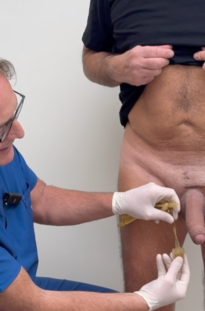
La Peyronie Prosthesis Implant: Scratch Technique Curvature Correction 0% 49 Views 0 Likes 6 January 2026 VIDEO GUIDE The La Peyronie prosthesis implant uses the “scratch technique” for Peyronie’s disease (penile induration), where surgeons break the fibrotic plaque with scissors or blade, then implant cylinders into the corpora cavernosa in 20-25 minutes while preserving penile length. The penis initially remains curved but less pronounced; inflated cylinders during cycling gradually straighten the curvature over 30-60 days without desensitization or infections due to surgical speed . La Peyronie prosthesis implant scratch technique targets the fibrous plaque causing painful erections and deformity. Precise plaque incision creates hinge defects that modeling cylinders exploit during inflation cycles. Unlike traditional plication (shortens penis), this method maintains preoperative stretched length while achieving functional straightness for intercourse . Post-La Peyronie prosthesis implant protocol combines device cycling with vacuum traction: inflate prosthesis inside vacuum device 1-2 hours daily. This dual therapy remodels fibrotic tissues, stretches residual plaque, and prevents capsule contracture. Patients achieve 90-95% straightness within 2 months, matching non-Peyronie’s implant outcomes . Surgical precision defines La Peyronie prosthesis implant success. Surgeons identify plaque location via preoperative ultrasound/Doppler, marking maximal deformity points. Intraoperative saline filling simulates erection to confirm hinge creation. Cylinder sizing accounts for fibrosis (slightly oversized for aggressive modeling), ensuring rigidity despite scarred tissues . The La Peyronie prosthesis implant scratch technique reduces operative time versus extensive plaque excision (45+ minutes). Minimal tissue disruption lowers infection risk (<1% high-volume centers) and preserves vascularity/blood flow. Antibiotics irrigate continuously; rapid closure prevents bacterial colonization . Vacuum therapy post La Peyronie prosthesis implant proves essential: negative pressure augments cylinder traction, breaking microscopic fibrous bands. Protocol: 10-15 minute sessions, 4-6x daily initially, tapering as straightness improves. Penile girth increases 10-15% naturally from tissue expansion; patients report enhanced flaccid appearance . Complication rates remain low with La Peyronie prosthesis implant scratch technique: cylinder cross-over <2%, distal erosion <1%, recurrent curvature 5-8% (usually <20° acceptable). Sensation preserved completely since dorsal nerve untouched. Manual dexterity sufficient for pump activation despite residual fibrosis . Patient selection optimizes La Peyronie prosthesis implant outcomes. Ideal candidates have stable disease (>12 months), 30-90° curvature, adequate preoperative length (>9 cm stretched). Contraindications: active inflammation (“acute phase”), hourglass deformity, or ventral-only curvature. Preoperative traction therapy 2-3 months pre-surgery improves surgical field . Long-term La Peyronie prosthesis implant data shows 92% satisfaction at 5 years, matching virgin implants. Partners report natural feel despite aggressive modeling. Device survival exceeds 95% at 10 years (AMS 700 LGX/Coloplast Titan). Secondary procedures rare (<3%) for residual curve or downsizing . Intraoperative decision-making differentiates La Peyronie prosthesis implant experts. Partial plaque incision suffices for 60° curves; complete circumferential scratch needed for >75°. Tinea corporoplasty (multiple relaxing incisions) reserved for extreme cases. Surgeon experience (>50 Peyronie’s implants) determines hinge reliability . Postoperative counseling emphasizes La Peyronie prosthesis implant commitment: daily 2-hour inflation mandatory first 90 days, vacuum compliance 80%+ success predictor. Patients notice progressive straightening week 3-4; full correction month 2. Early intervention prevents autoinflation or tissue memory . La Peyronie prosthesis implant scratch technique revolutionizes complex Peyronie’s management, converting surgical challenge into routine procedure. High-volume centers achieve cosmetic/functional results rivaling non-fibrotic cases, validating technique evolution from excision to minimally invasive modeling. (Visited 49 times, 1 visits today) Show more cylinder-implantationLa-Peyronie-prosthesispenile-curvature-correctionplaque-rupturepost-op-vacuumrapid-Peyronie-implantscratch technique 02:56 PREV Infrapubic Approach Penile Prosthesis: Concealed vs Penoscrotal 6 January 2026 05:33 NEXT Post-Operative Penile Prosthesis Management: First Precautions 6 January 2026 You might be interested in 0 00:41 Post-Operative Hygiene After Penile Prosthesis: First Week Care 6 January 2026 0 01:31 Post-Operative Penile Prosthesis Care: Avoid Traction and Pump Management 6 January 2026 0 03:39 Penile Prosthesis Suture Removal: Timing and Safe Procedure 6 January 2026 0 01:41 Penile Prosthesis Management After First Week: Cycling Protocol 6 January 2026 0 02:09 Deflating Penile Prosthesis Drain: Home Management Protocol 6 January 2026 0 01:36 Penile Prosthesis Drainage Management: Post-Op Protocol 6 January 2026