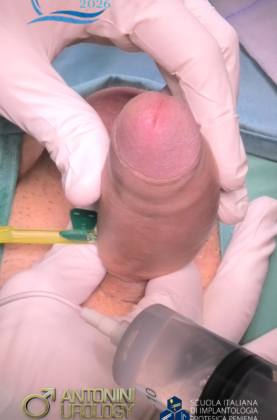
The surgical procedure shown in this video was performed by Prof. Gabriele Antonini. These images, intended for a medical audience and educational purposes, may be intense for those unaccustomed to surgical scenes.
The video demonstrates the surgical procedure for the removal of an extrusion caused by phimosis. Phimosis refers to the narrowing of the foreskin, which makes it difficult or impossible to fully and comfortably expose the glans (the head of the penis). The foreskin is the skin that covers the glans.
Phimosis can manifest in varying degrees:
– Mild phimosis: The glans is hard to uncover only during an erection. This condition might cause discomfort during sexual activity but doesn’t typically lead to hygiene issues.
– Moderate phimosis: The glans can only partially be uncovered even when flaccid. This may cause both sexual discomfort and hygiene difficulties, leading to complications like infections.
– Severe phimosis: The glans cannot be uncovered at all, resulting in compromised hygiene and frequent infections. In advanced cases, urination may also become challenging.
The causes of phimosis can be:
– Congenital: The foreskin remains tight even after puberty instead of loosening as it typically should.
– Acquired: Post-puberty conditions often due to infections (e.g., balanoposthitis) that cause scarring and narrowing of the foreskin.
Phimosis is a benign condition but can significantly impact a person’s quality of life. Diagnosis is straightforward, usually evident through the patient’s inability to retract the foreskin. For mild cases where phimosis occurs only during erections, additional patient discussion may clarify the diagnosis.
The most common surgical solution is circumcision, performed under local anesthesia applied circumferentially at the base of the penis. This procedure involves complete removal of the foreskin, leaving the glans fully exposed. Sutures are absorbable, healing occurs in about two weeks, and sexual activity can typically resume after 3–4 weeks. Initially, increased sensitivity of the exposed glans may occur but usually diminishes as keratinization develops.
Potential complications include scarring or keloid formation, which may cause psychological distress in some patients. Proper post-operative care, including anti-inflammatory creams, can assist in recovery and prevent such issues.