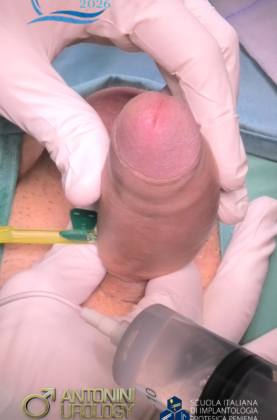
Peyronie’s disease, also known as induratio penis, is a clinical condition characterized by the formation of fibrous plaques inside the penis, leading to deformity, pain, and difficulties in sexual function. While initial treatment may be conservative (pharmacological therapy, penile traction, shockwave therapy), in severe or therapy-resistant cases, prosthetic implantation represents a highly effective and definitive option.
The three-component prosthetic implant is one of the most advanced solutions for patients with erectile dysfunction and Peyronie’s disease. This type of implant consists of three main components: the inflatable cylinders, the pump, and the reservoir. The inflatable cylinders are inserted into the penile corpora cavernosa, while the pump is placed in the scrotum, and the reservoir is implanted in the abdomen. The pump allows the patient to inflate the cylinders when an erection is desired, thus restoring sexual function in a natural and discreet manner.
Surgical treatment of Peyronie’s disease with a three-component prosthetic implant is highly recommended for patients with significant deformity, persistent pain, or difficulties in sexual penetration. The surgery requires a thorough evaluation by a urologist, who must consider the patient’s general health, the severity of the disease, and the quality of their sexual life.
An innovative aspect of the treatment is the introduction of the scratch maneuver. This procedure is performed during surgery to enhance the functionality of the implant and correct any remaining penile deformities. The maneuver involves careful manipulation of the penile tissues to stimulate the release of fibrous plaques, thereby improving the effectiveness of the prosthetic implant. Although the scratch maneuver is not always necessary, it is often performed to ensure an optimal aesthetic and functional result.
The Department of Gynecological-Obstetrical and Urological Sciences at the University of Rome La Sapienza, under the direction of Prof. V. Gentile, has long been involved in research and the implementation of advanced surgical techniques for the treatment of sexual dysfunctions and urological diseases. Collaboration with international institutions such as Coral Gables Hospital in Florida, USA, led by the renowned urologist Paul E. Perito, has enriched the therapeutic landscape with modern and innovative approaches, contributing to the improvement of surgical techniques and the training of highly qualified specialists.
The three-component prosthetic implant has proven to offer significant benefits for patients with Peyronie’s disease, improving not only sexual function but also overall quality of life. Patients undergoing this surgery report high levels of satisfaction and a tangible improvement in their sexual and relational lives.